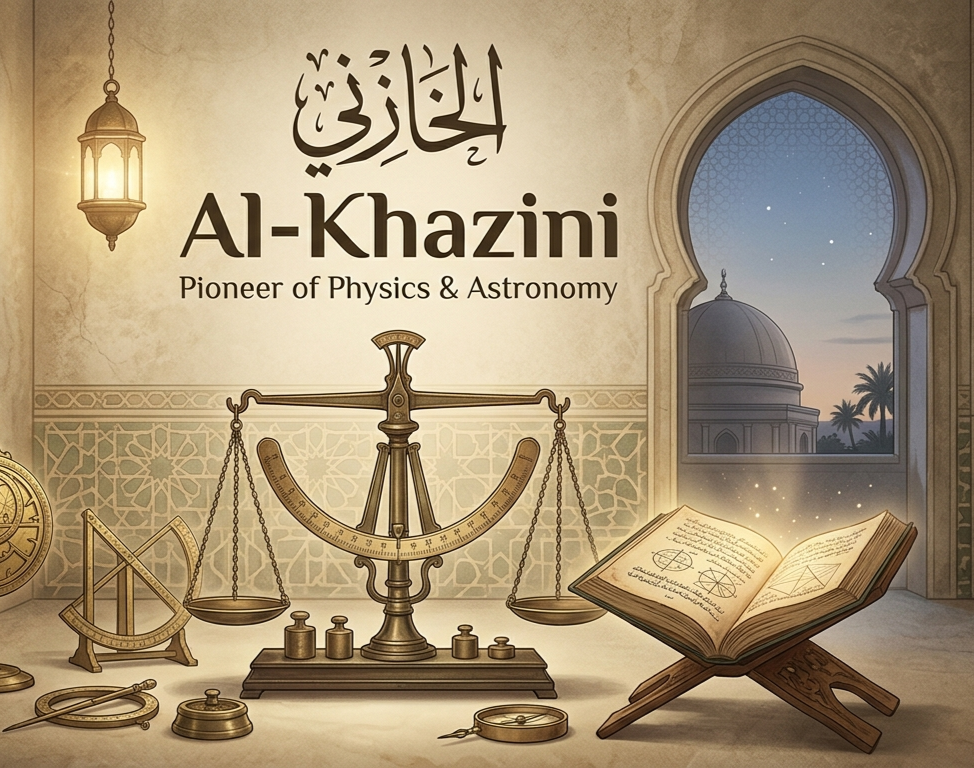
Al-Khazini – Pioneer of Physics, Astronomy and Measurement Sciences
Al-Khazini was a distinguished Muslim scientist of the 12th century, known for his remarkable contributions to physics, astronomy, and the science of measurement. He lived during the Islamic Golden Age, a period when scientific knowledge flourished across the Muslim world.
Al-Khazini is believed to have worked under the patronage of Sultan Sanjar of the Seljuk Empire. Although little is known about his early life, historical accounts suggest that he was originally of Greek origin and later became associated with Islamic scholarly traditions.
---
Field of Expertise:
Al-Khazini made significant contributions in the following fields:
• Physics
• Astronomy
• Hydrostatics
• Mechanics
• Measurement Science
His work focused heavily on precision, experimentation, and understanding the physical properties of matter.
---
Major Contributions:
Al-Khazini is especially known for advancing the science of hydrostatics, which deals with the behavior of fluids at rest. He designed highly accurate instruments for measuring the density and weight of substances, improving earlier methods developed by Greek scientists.
He studied the concept of weight and gravity, proposing ideas about the variation of weight depending on distance from the center of the Earth. His work reflects an early understanding of gravitational principles, long before modern physics.
He also refined the use of balances and scales, making them more precise for scientific experimentation. His emphasis on accuracy and observation played a key role in the development of experimental science.
---
Famous Works:
Al-Khazini is primarily known for his major work:
• Kitab Mizan al-Hikma (The Book of the Balance of Wisdom)
This book is one of the most important scientific texts of the medieval Islamic world. It discusses the principles of weight, density, hydrostatics, and the use of precise measuring instruments.
The work combines theoretical knowledge with practical experiments, demonstrating Al-Khazini’s deep understanding of both science and methodology.
Due to limited historical records, no other major works are definitively attributed to Al-Khazini.
---
Scientific Contributions in Detail:
In his work, Al-Khazini described methods to determine the density of various materials using water displacement techniques. He also discussed the concept of specific gravity and developed instruments capable of highly accurate measurements.
He improved earlier theories by introducing more refined calculations and practical experimentation, which helped establish a more scientific approach to physical studies.
---
Legacy:
Al-Khazini’s contributions had a lasting impact on the development of physics and engineering. His work influenced later scholars in both the Islamic world and Europe.
He is regarded as one of the pioneers of experimental science, particularly in the field of measurement and hydrostatics. His emphasis on precision and observation remains an important part of scientific methodology.
His legacy reflects the rich intellectual tradition of the Islamic Golden Age, where scholars combined knowledge, observation, and innovation to advance human understanding.
Discussion 0
You must be logged in to participate in the discussion.
Login to CommentNo comments yet. Be the first to start the conversation!