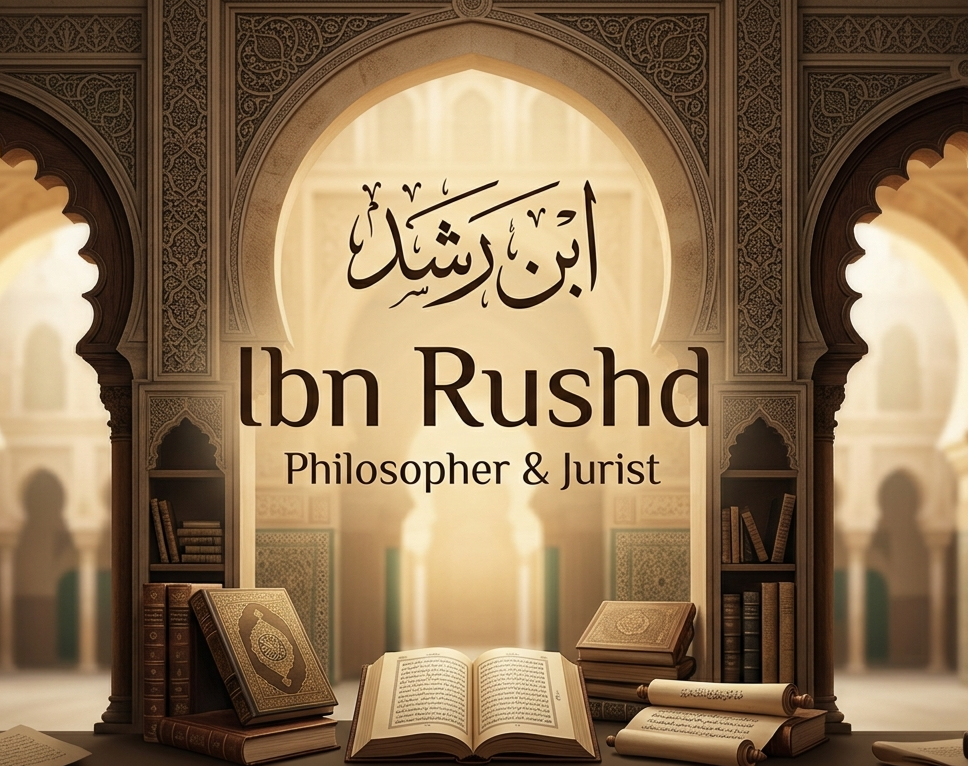
Ibn Rushd (Averroes) – Philosopher, Judge and Defender of Reason
Ibn Rushd (1126–1198 CE), known in the Latin West as Averroes, was one of the most influential philosophers, jurists, and physicians of the Islamic Golden Age. He was born in Cordoba (Qurtuba), in present-day Spain, into a distinguished family of scholars and judges. His grandfather and father both served as Qadis (judges), which deeply influenced his early education in Islamic law and theology.
From a young age, Ibn Rushd displayed exceptional intellectual ability. He studied a wide range of subjects, including Islamic jurisprudence (fiqh), theology (kalam), philosophy, medicine, and logic. His education combined both religious sciences and rational sciences, making him one of the most well-rounded scholars of his time.
---
Early Life and Education:
Ibn Rushd grew up in an environment rich in scholarship. He received formal training in Maliki jurisprudence, which was the dominant legal school in Al-Andalus. Alongside this, he studied philosophy and science, gaining deep knowledge of Aristotle’s works.
His intellectual journey was greatly influenced by Ibn Tufail, who later introduced him to the Almohad ruler Abu Yaqub Yusuf. This connection opened doors for Ibn Rushd to engage in philosophical and scientific work at a higher level.
---
Field of Expertise:
Ibn Rushd made major contributions in several fields:
• Philosophy
• Islamic Law (Fiqh – Maliki school)
• Medicine
• Logic
• Theology
He is especially renowned for his efforts to reconcile philosophy with Islamic teachings.
---
Major Contributions:
One of Ibn Rushd’s greatest contributions was his extensive commentary on Aristotle’s works. He wrote short, medium, and long commentaries that explained complex philosophical ideas in a clear and systematic way.
He strongly believed that reason and revelation are not contradictory. According to him, both philosophy and religion aim at the same truth, but they approach it in different ways. He argued that those with the ability to reason should engage in philosophical thinking to better understand the world.
In response to Imam Al-Ghazali’s famous work "Tahafut al-Falasifa" (The Incoherence of the Philosophers), Ibn Rushd wrote "Tahafut al-Tahafut" (The Incoherence of the Incoherence), defending the role of philosophy and rational inquiry.
---
Famous Works:
Ibn Rushd was a highly prolific scholar who is estimated to have authored more than 70 works across various fields, including philosophy, Islamic law, medicine, and logic.
Some of his most well-known and surviving works include:
• Tahafut al-Tahafut (The Incoherence of the Incoherence)
• Fasl al-Maqal (Decisive Treatise on the harmony between religion and philosophy)
• Kashf ‘an Manahij al-Adillah
• Bidayat al-Mujtahid wa Nihayat al-Muqtasid (a major work in Islamic jurisprudence)
• Kulliyat fi al-Tibb (General Principles of Medicine, known in Latin as Colliget)
In addition to these, Ibn Rushd wrote extensive commentaries on the works of Aristotle. These were categorized into:
• Short Commentaries (Jami‘)
• Middle Commentaries (Talkhis)
• Long Commentaries (Tafsir)
These commentaries covered major philosophical subjects such as logic, physics, metaphysics, and ethics.
Many of Ibn Rushd’s works were translated into Latin and Hebrew and became central to intellectual life in medieval Europe.
Due to the passage of time, many of his original writings have been lost, but his surviving works continue to be studied worldwide.
---
Role in Medicine:
In addition to philosophy and law, Ibn Rushd was also a skilled physician. His medical work "Kulliyat fi al-Tibb" (known in Latin as Colliget) was widely studied in medieval Europe. It focused on general medical principles and complemented more specialized medical texts.
---
Intellectual Influence:
Ibn Rushd’s influence extended far beyond the Islamic world. His works were translated into Latin and Hebrew and became central to European intellectual life during the Middle Ages.
In Europe, he was known as Averroes and was considered one of the greatest commentators on Aristotle. His ideas played a significant role in shaping Western philosophy, particularly during the Scholastic period.
---
Challenges and Opposition:
Despite his contributions, Ibn Rushd faced opposition from certain groups who were critical of philosophical thought. Toward the end of his life, he experienced political and intellectual challenges, including temporary exile.
However, his works survived and continued to spread across different regions.
---
Legacy:
Ibn Rushd is remembered as a defender of reason and a bridge between different intellectual traditions. His efforts to harmonize faith and reason remain relevant even today.
He stands as one of the most important figures in both Islamic and global intellectual history. His works continue to be studied by scholars of philosophy, law, and science across the world.
His legacy reflects a time when knowledge, inquiry, and critical thinking were central to the advancement of civilization.
Discussion 0
You must be logged in to participate in the discussion.
Login to CommentNo comments yet. Be the first to start the conversation!