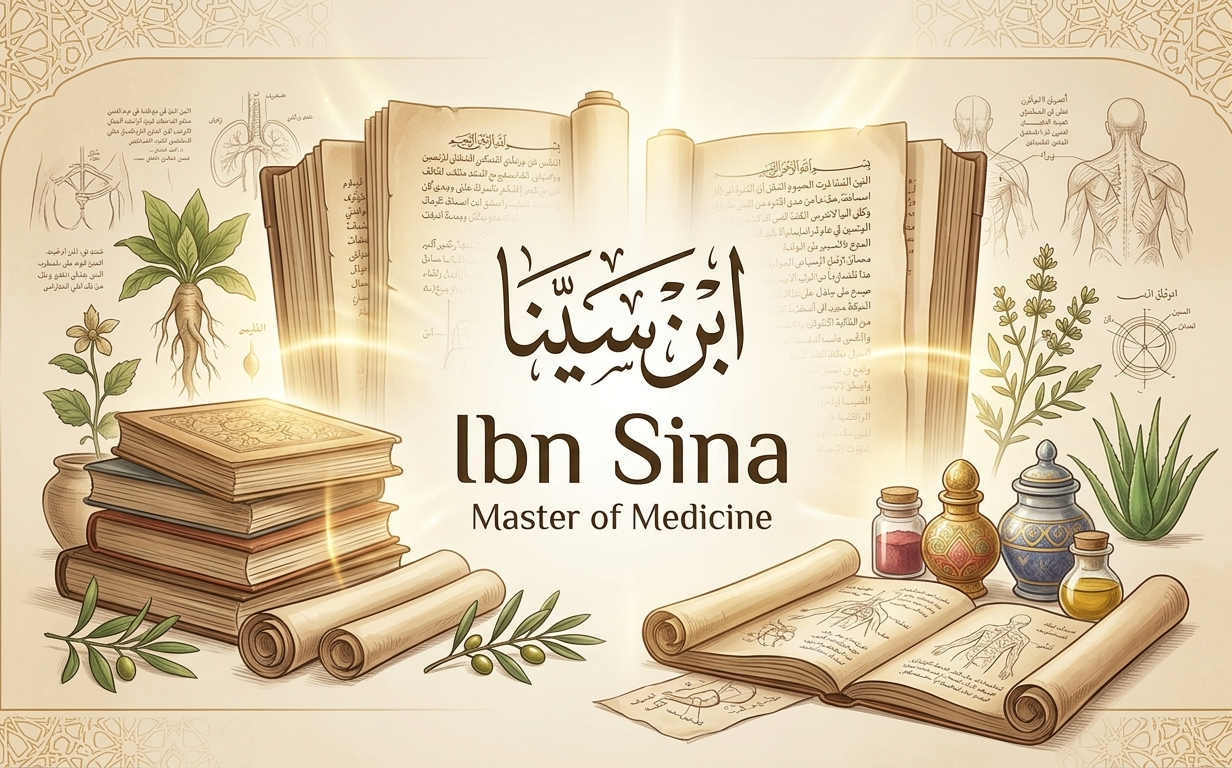
Ibn Sina (Avicenna) – Master of Medicine and Philosophy
Ibn Sina (980–1037 CE), known in the Latin West as Avicenna, was one of the greatest physicians, philosophers, and polymaths of the Islamic Golden Age. His full name was Abu Ali al-Husayn ibn Abd Allah ibn Sina. He was born in Afshana, near Bukhara (in present-day Uzbekistan), and became one of the most influential figures in the history of medicine and philosophy.
His works shaped medical science, philosophy, and education for centuries across both the Islamic world and Europe.
---
Early Life and Education:
Ibn Sina was born in 980 CE into a scholarly family. His father was a respected official and ensured that Ibn Sina received a strong early education.
By the age of 10, Ibn Sina had memorized the Qur’an and mastered basic Islamic sciences. He then studied logic, mathematics, philosophy, and medicine. His intellectual abilities were extraordinary — by the age of 18, he had already become a skilled physician.
He gained access to the royal library of the Samanid rulers, where he studied a vast collection of books, further expanding his knowledge.
---
Field of Expertise:
Ibn Sina made major contributions in multiple fields:
• Medicine
• Philosophy
• Mathematics
• Astronomy
• Physics
• Logic
• Psychology
He is especially regarded as a pioneer in early medical science and a leading philosopher.
---
Total Works and Scholarly Output:
Ibn Sina was an extremely prolific writer. It is widely accepted that:
• He authored more than 450 works across various disciplines
• Around 240 of these works are known, and approximately 150 have survived in full or partial form
• His writings include large encyclopedic books, shorter treatises (rasā’il), and commentaries
Many of his works were translated into Latin and became central to European education.
---
Major Contributions in Medicine:
Ibn Sina’s most important contribution to medicine is his comprehensive medical encyclopedia:
• Al-Qanun fi al-Tibb (The Canon of Medicine)
This multi-volume work became one of the most influential medical texts in history. It was used as a standard textbook in European universities for several centuries.
In this work, Ibn Sina:
• Systematically organized medical knowledge
• Described diseases and their treatments
• Discussed pharmacology and drug interactions
• Emphasized clinical trials and observation
He also identified contagious diseases and recognized the importance of hygiene and diet in maintaining health.
---
Philosophical Contributions:
Ibn Sina made major contributions to philosophy, particularly in metaphysics and logic. His most important philosophical work is:
• Kitab al-Shifa (The Book of Healing)
Despite its name, this work is not about medicine but is a comprehensive philosophical and scientific encyclopedia.
In it, he explored:
• Logic
• Natural sciences
• Psychology
• Metaphysics
His philosophical ideas influenced both Islamic scholars and later European thinkers such as Thomas Aquinas.
---
Other Major Works:
Ibn Sina authored numerous works across disciplines, including:
Medicine:
• Al-Qanun fi al-Tibb
Philosophy:
• Kitab al-Shifa
• Al-Najat (The Book of Salvation)
Logic and Science:
• Various treatises on logic, physics, and astronomy
Short Treatises:
• Numerous rasā’il on specific topics in science and philosophy
---
Scientific Approach:
Ibn Sina emphasized observation, experimentation, and logical reasoning. He combined theoretical knowledge with practical experience, especially in medicine.
His approach to diagnosis and treatment laid the groundwork for modern clinical practices.
---
Legacy:
Ibn Sina is regarded as one of the greatest minds in history. His works influenced both the Islamic world and Europe for centuries.
His medical texts remained standard references until the 17th century, and his philosophical ideas shaped intellectual traditions across cultures.
He is remembered as a symbol of intellectual excellence, whose contributions to medicine and philosophy continue to be recognized worldwide.
His legacy represents the height of scientific and philosophical achievement during the Islamic Golden Age.
Discussion 0
You must be logged in to participate in the discussion.
Login to CommentNo comments yet. Be the first to start the conversation!