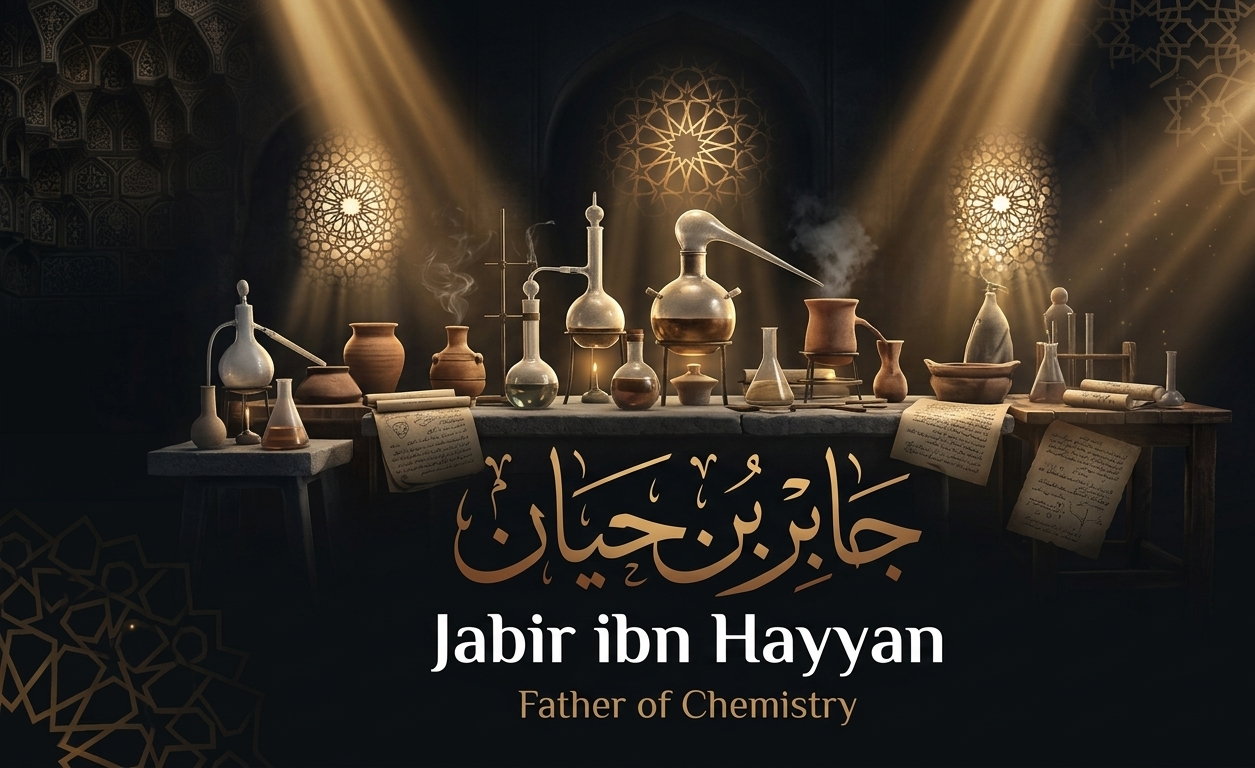
Jabir ibn Hayyan – Pioneer of Chemistry and Experimental Science
Jabir ibn Hayyan (c. 721–815 CE), known in the Latin West as Geber, was one of the most influential scientists of the Islamic Golden Age and is widely regarded as the father of chemistry. He was born in the early 8th century and is believed to have lived in Kufa (present-day Iraq).
Jabir transformed the ancient practice of alchemy into a systematic and experimental science, laying the foundation for modern chemistry.
---
Early Life and Background:
Jabir ibn Hayyan is believed to have studied under the guidance of prominent scholars of his time, including Imam Ja'far al-Sadiq. His intellectual environment allowed him to explore both philosophical and experimental sciences.
He lived during the Abbasid period, a time when scientific knowledge was actively being developed and translated.
---
Field of Expertise:
Jabir ibn Hayyan made major contributions in:
• Chemistry (Alchemy → Chemistry)
• Experimental Science
• Pharmacy
• Metallurgy
He is especially known for introducing laboratory-based scientific methods.
---
Total Works and Scholarly Output:
Jabir ibn Hayyan was an extremely prolific writer. It is estimated that:
• More than 100 works are attributed to him
• A significant number of these are preserved in Arabic and Latin translations
• His writings include books, treatises (rasā’il), and detailed experimental notes
Some of his works may have been compiled by later scholars, but his influence remains undeniable.
---
Major Contributions:
Jabir ibn Hayyan introduced a systematic experimental approach to chemistry. He emphasized observation, experimentation, and repeatability — key principles of modern science.
He developed and improved many chemical processes, including:
• Distillation
• Crystallization
• Filtration
• Sublimation
These processes are still fundamental techniques used in modern laboratories.
---
Laboratory Innovations:
Jabir designed and used advanced laboratory equipment for his time, including:
• Alembic (distillation apparatus)
• Chemical furnaces
• Measuring tools
He is considered one of the first scientists to establish a laboratory-based approach to science.
---
Chemical Discoveries:
Jabir ibn Hayyan worked with various substances and is credited with:
• Preparation of acids such as nitric acid and hydrochloric acid
• Development of aqua regia (a mixture capable of dissolving gold)
• Classification of substances into different categories
His work helped transform chemistry into a structured scientific discipline.
---
Scientific Method:
Jabir emphasized:
• Experimentation over speculation
• Accuracy in observation
• Reproducibility of results
This marked a major shift from mystical alchemy to empirical science.
---
Legacy:
Jabir ibn Hayyan’s work had a profound impact on both the Islamic world and Europe. His writings were translated into Latin and studied by European scholars, influencing the development of chemistry during the Renaissance.
He is remembered as one of the pioneers who transformed science into an experimental discipline.
---
Modern-Day Impact:
The influence of Jabir ibn Hayyan is still visible in the modern world today.
The laboratory techniques he developed — such as distillation, filtration, and crystallization — are still used in chemistry labs, pharmaceutical industries, and scientific research.
Modern chemistry, chemical engineering, and even industries like medicine, manufacturing, and environmental science rely on the experimental methods that he helped establish.
The concept of conducting controlled experiments, which is now a fundamental part of scientific research, can be traced back to the methods introduced by Jabir.
In essence, every modern laboratory, chemical process, and scientific experiment carries the legacy of Jabir ibn Hayyan’s work.
His contributions are not just part of history — they are actively shaping the world we live in today.
Discussion 0
You must be logged in to participate in the discussion.
Login to CommentNo comments yet. Be the first to start the conversation!