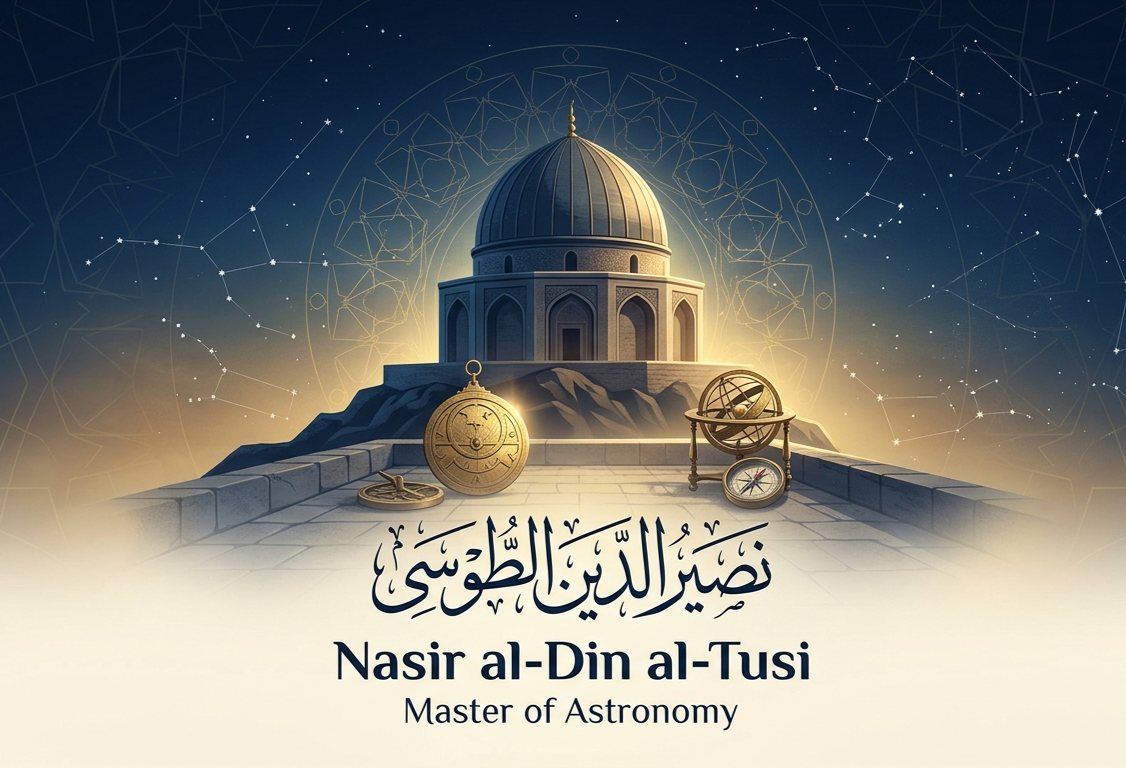
Nasir al-Din al-Tusi – Master of Astronomy, Mathematics and Philosophy
Nasir al-Din al-Tusi (1201–1274 CE) was one of the greatest polymaths of the Islamic Golden Age, whose contributions spanned astronomy, mathematics, philosophy, theology, logic, and ethics. Born in the city of Tus in present-day Iran, he became one of the most influential scientific minds in medieval history.
He lived during a time of major political and intellectual transformation and played a central role in advancing scientific knowledge, particularly through his work at the famous Maragha Observatory.
---
Early Life and Education:
Al-Tusi received a comprehensive education in both religious and rational sciences. He studied theology, philosophy, mathematics, and astronomy from an early age. His intellectual curiosity and analytical ability quickly distinguished him as a leading scholar.
---
Total Works and Scholarly Output:
Nasir al-Din al-Tusi was an extremely prolific writer. It is widely accepted among historians that:
• He authored more than 120 works, with some estimates placing the number above 150
• These works include full-length books, short treatises (rasā’il), commentaries, and revisions of earlier classical texts
Out of these:
• Approximately 60 to 80 works are known, preserved, and studied today
• Several works have been lost over time or survive only in fragments
His writings covered a wide range of disciplines, making him one of the most versatile scholars in Islamic history.
---
Field of Expertise:
Al-Tusi made major contributions in multiple fields, including:
• Astronomy
• Mathematics
• Physics
• Philosophy
• Theology
• Logic
• Ethics
He is especially known for integrating mathematical precision with philosophical reasoning.
---
Major Contributions:
One of Al-Tusi’s greatest achievements was the establishment of the Maragha Observatory, one of the most advanced scientific research centers of its time. Under his leadership, scholars conducted precise astronomical observations and developed improved planetary models.
He introduced the famous “Tusi Couple,” a mathematical device used to generate linear motion from circular motions. This concept later influenced the development of astronomical models in Europe, including those associated with Copernicus.
---
Major Works (By Category):
Astronomy:
• Zij-i Ilkhani
• Tahrir al-Majisti (Commentary on Ptolemy’s Almagest)
• Risala fi al-Hay'a (Treatise on Astronomy)
Mathematics:
• Kitab al-Shakl al-Qatta
• Tahrir Euclid (Revision of Euclid’s Elements)
• Risala fi al-Jabr
Philosophy and Theology:
• Tajrid al-I'tiqad
• Sharh al-Isharat wa al-Tanbihat (Commentary on Ibn Sina’s work)
Ethics:
• Akhlaq-i Nasiri
Logic:
• Asas al-Iqtibas
Other Scientific Treatises:
• Works on mechanics, geometry, and natural sciences
• Various short treatises (rasā’il) on specific scientific and philosophical topics
---
Scientific Method and Approach:
Al-Tusi emphasized observation, precision, and mathematical reasoning. His work reflects a strong commitment to scientific methodology, combining theoretical analysis with practical experimentation.
---
Legacy:
Nasir al-Din al-Tusi’s influence extended far beyond the Islamic world. His contributions to astronomy and mathematics played a role in shaping later developments in Europe.
He is regarded as one of the key figures in the transition from classical to more advanced scientific thinking. His work at the Maragha Observatory set new standards for scientific research institutions.
His legacy represents the intellectual richness of the Islamic Golden Age, where scholars pursued knowledge across disciplines with depth and rigor.
Discussion 0
You must be logged in to participate in the discussion.
Login to CommentNo comments yet. Be the first to start the conversation!